Young Women Building Their Future Project Social Impact Analysis (SROI)
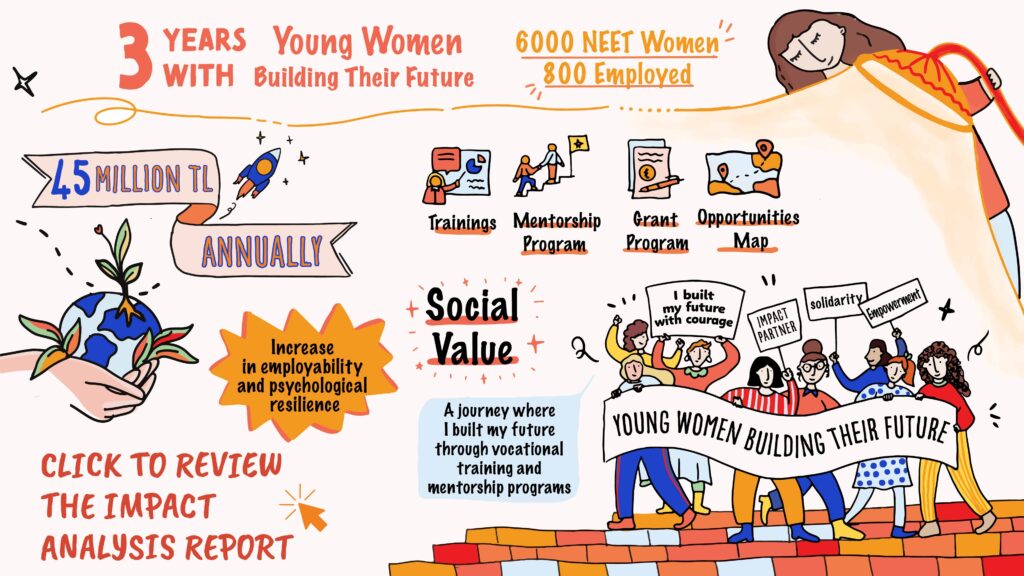
To measure the impact of the Young Women Building Their Future Project, the Social Return on Investment (SROI) methodology was applied. SROI is an analytical approach that assesses the social and economic value created by social-based projects. This method expresses the changes generated by project investments on individuals and society in financial terms, allowing for the calculation of a social return ratio.
For example, an SROI ratio of 2 indicates that every 1 unit of investment has generated 2 units of social value. A ratio above 1 indicates that the investment has generated positive returns, demonstrating the project’s success. The SROI ratio highlights the project’s effectiveness and sustainability. According to the SROI analysis of the Young Women Building Their Future Project, every 1 TL invested in the project has generated 4 TL in social return, resulting in an annual social value of 45 million TL.
The Theory of Change is an approach used to understand how a project accomplishes its goals and impacts beneficiaries throughout its implementation. The Theory of Change developed for the Young Women Building Their Future Project highlights how participants achieve positive changes in self-confidence, empowerment, psychological resilience, awareness, and employability through trainings, mentorship programs, and other support mechanisms. This transformation ultimately enhances women’s participation in the workforce and promotes gender equality in the long term.
To assess the project’s impact, surveys and focus group discussions were conducted with participants of empowerment and vocational training programs, as well as mentors and mentees from the Mentorship Program.
Key Findings and Insights
According to the SROI analysis, the project has significantly enhanced NEET young women’s self-confidence, empowerment, awareness, emotional resilience, well-being, social support networks, and employability. The findings provide valuable insights into the ways in which the project has promoted the empowerment, employability, and social inclusion of NEET young.
Key outcomes include:
- Through the Empowerment/Life Skills Trainings, participants experienced a strong sense of personal growth, with improvements in awareness, confidence, well-being, and social support. Young women emphasized that learning about women’s rights, family relationships, and social life made them feel significantly more empowered.
- Vocational training participants demonstrated improvements in knowledge and skills, well-being, employability, and self-confidence.
- Mentorship Program participants demonstrated notable increases in supportive relationships, networking, emotional resilience, and employability. According to a survey conducted with mentors, the most significant area of change was ‘creating social impact and motivation. Overall, the highest rates of positive change were observed among Mentorship Program participants.
Across all participant groups, there was a significant rise in motivation to engage in job-seeking activities, including CV updates, job applications, and interview attendance, indicating tangible steps toward workforce integration.